



2026.09.01
The Port Town Loved by Joseon Envoys | History of International Exchange Remaining in Tomonoura
Tomonoura Historical Chronicles
Tomonoura Historical Chronicles Vol. 7
Tomonoura, which flourished as a port for waiting out tides, preserves countless stories of people who visited, departed from, and dearly cherished this town.
"Tomonoura Historical Chronicles" is a 12-part series introducing notable historical figures and events connected to Tomonoura.
Part 7 features the "Joseon Tongsinsa" (Korean Envoys) who crossed the sea to visit Japan during the Edo period.
When thinking of Tomonoura, many picture the Joyato lantern, traditional townhouses, and peaceful Seto Inland Sea scenery. Yet during the Edo period, diplomatic envoys from the Korean Peninsula arrived at this port, building rich cultural exchanges with the Japanese people.
A primary stage for these historic encounters was the Taichoro guest hall of Fukuzenji Temple, which remains preserved in Tomonoura today.
Here, we explore who the Joseon Envoys were, how Tomonoura welcomed them, and the international exchange history preserved in this port town.
The "Joseon Tongsinsa" Crossing the Sea to Visit Japan
The Joseon Tongsinsa were diplomatic delegations dispatched from the Kingdom of Joseon to Japan.
During the Edo period, envoys arrived to coincide with events such as the succession of a new Shogun, traveling from Tsushima through the Seto Inland Sea to Osaka, Kyoto, and ultimately Edo.
In addition to diplomatic officials, delegations included scholars, calligraphers, and painters. Wherever they visited, cultural exchanges took place with Japanese scholars and intellectuals. Through written conversations using Chinese characters, classical poetry, and calligraphy, cross-border cultural dialogue flourished.
Strolling through modern Tomonoura, learning that international envoys once visited this town may feel surprising. Experiencing such international history breathing within our daily streetscapes deepens our appreciation for Tomonoura's heritage.
A Port for Waiting Out Tides Welcoming International Envoys
Located along the maritime route of the Joseon Envoys, Tomonoura was historically a crucial harbor gathering ships navigating the Seto Inland Sea.
Sea voyages of that era progressed by reading tides and winds. Situated near the center of the Seto Inland Sea, Tomonoura developed as a key harbor for "waiting out tides," drawing numerous vessels.
 The Kitamaebune merchant vessels introduced in Vol. 6 were among the ships calling at this port.
As a bustling hub where merchants, sailors, commodities, and news gathered, Tomonoura played a vital role in hosting the Joseon Envoys.
While today it is a tranquil harbor frequented by fishing boats and ferries, during the Edo period it welcomed ships from across Japan alongside foreign delegations from across the sea. Gazing over the harbor while imagining those historic arrivals highlights how Tomonoura was connected to distant lands via the ocean.
Fukuzenji Taichoro: The Stage for International Exchange
When the Joseon Envoys visited Tomonoura, the Taichoro guest hall of Fukuzenji Temple served as their official reception venue.
Built around 1690 atop stone walls facing the sea, Taichoro offers panoramic views of Bentenjima Island, Sensui Island, and the Seto Inland Sea beyond from its tatami hall.
Here, envoys interacted with Japanese hosts, leaving behind remarkable works of calligraphy and poetry.
 In 1711, Yi Bang-eon, an official accompanying the delegation, praised the view from Taichoro as "Nitto Daiichi Keisho" (The Finest View in East Asia). Today, a wooden plaque displaying his original calligraphy remains on display.
When visiting Taichoro, look beyond the architecture and plaques to gaze at the sea visible from the tatami room.
The scenery of Bentenjima and Sensui Island we admire today was beheld from this very room by travelers who crossed the sea over 300 years ago. Standing in the exact same spot reconnects us with living history.
Memories of Exchange Preserved in Calligraphy & Poetry
What remains at Taichoro extends beyond praise for scenic beauty.
During visits by the Joseon Envoys, dialogue took place with Japanese Confucian scholars and calligraphers, leaving behind rich collections of poetry and brushwork.
People arriving from across the ocean and hosts welcoming them in Tomo gathered in the same room, exchanging ideas through classical text. It was a scene uniquely characteristic of Tomonoura's port history.
The poetry and calligraphy left by envoys were carefully preserved over generations. In the Edo period, scholars such as Kan Chazan even created woodblocks to print and share these works widely.
Gazing at the calligraphy displayed in Taichoro's tatami hall conveys that this hall was not merely a scenic spot, but a meeting place for diverse people and cultures.
The Joseon Envoys & Tomo's Specialty "Homeishu"
Tracing connections between the Joseon Envoys and Tomonoura leads to Tomo's famous specialty, "Homeishu" liquor.
Produced since the Edo period, Homeishu was served to the Joseon Envoys, who left behind classical poems praising its rich, medicinal flavor.
 Strolling through Tomo today, you will encounter shops and breweries selling Homeishu.
Walking through town after learning this history gives familiar "Homeishu" signboards a new perspective. After visiting Taichoro, we recommend exploring local streets in search of Homeishu shops.
Returning to Tomo After 261 Years: Reconstructed Joseon Envoy Ship
The connection between the Joseon Envoys and Tomonoura is not confined to the Edo period.
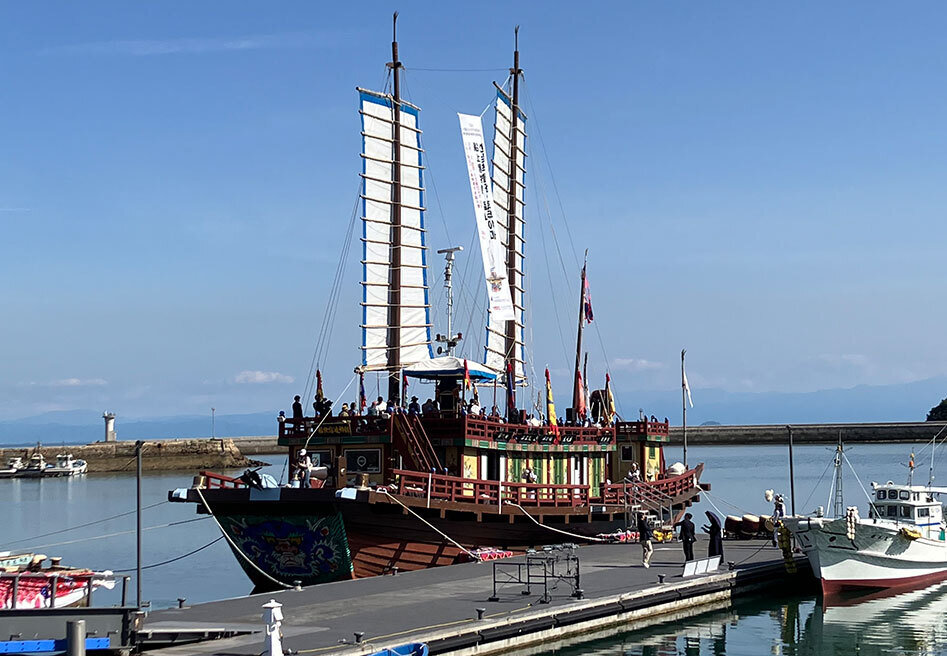
In May 2025, commemorating the Osaka-Kansai Expo and the 60th anniversary of the normalization of diplomatic relations between Japan and South Korea, a reconstructed Joseon Envoy ship built in South Korea sailed from Busan to Osaka along the historic maritime route.
The reconstructed vessel arrived in Tomonoura on May 7. On May 8, a welcoming ceremony took place in front of the Joyato lantern, followed by onboard public tours at the floating pier near the Tomonoura Fishery Cooperative. It marked the first time in 261 years--since 1764--that a Joseon Envoy ship docked in Tomo.
 The vibrant vessel floating in Tomo Port created an extraordinary scene, overlaying historic memories onto present-day scenery.
Nearly 300 years ago, people crossed ocean waters to connect in Tomonoura. Seeing that international friendship renewed in this port reaffirmed Tomonoura's enduring legacy as a doorway to the world.
Staff Recommendation: From Taichoro into Town
To trace the history of the Joseon Envoys, our staff recommends visiting Fukuzenji Taichoro first, then strolling leisurely through the historic town center.
After admiring the Seto Inland Sea from Taichoro, walk down the slope through narrow alleys lined with traditional townhouses toward the harbor.
Along the way, you will pass Homeishu shops, leading onward to iconic harbor landmarks like the Joyato lantern and Gangi stone steps.
Rather than rushing to your next destination, take time to enjoy an unhurried walk through town.
Every time we walk these streets, we are reminded of how closely temples, townhouses, and the port are clustered together. Walking the path connecting the envoy reception hall to the historic port reveals how Tomonoura's rich history weaves together seamlessly.
Tomonoura: Connected Beyond the Seas
Today, Tomonoura is a tranquil port town preserved alongside calm inland seas.
Tracing its history reveals a dynamic past where Kitamaebune docked, merchants and travelers gathered, and international envoys stepped ashore.
As ships arrived, people, commodities, news, and cultures intermingled.
Throughout its long history, Tomonoura was a port connected not only to regions across Japan, but across the oceans to foreign lands.
When visiting Hotel Ofutei, after exploring Fukuzenji Taichoro, take a scenic detour through town toward the port.
Gaze over the sea from Taichoro, wander narrow alleys, browse Homeishu shops, and head toward the harbor.
Walking in that order brings the era of the Joseon Envoys vividly to life amidst present-day streetscapes.
In our next issue of "Tomonoura Historical Chronicles," we will introduce the breathtaking views from Fukuzenji Taichoro--praised by Joseon Envoys as "Nitto Daiichi Keisho"--alongside the stories preserved there.
【Reference Materials】
▷ Fukuyama City: "History of Tomo-cho (Early Modern)"
▷ Fukuyama City: "Fukuzenji Taichoro"
▷ Fukuyama City: "About Tomonoura"
▷ Fukuyama City: "Joseon Tongsinsa"
▷ Agency for Cultural Affairs Japan Heritage Portal: "Reconstructed Joseon Envoy Ship Arrived in Tomo!"
▷ Tomonoura History & Folklore Museum: "The Reconstructed Joseon Envoy Ship Is Coming"
The emojis on this site use Twemoji (© Twitter, Inc. and contributors). License: CC-BY 4.0