



2026.08.25
History of Tomo Castle Ruins & Tomonoura | Walking Through a Port Town That Flourished as a Seto Inland Sea Hub
Tomonoura Historical Chronicles
Tomonoura Historical Chronicles Vol. 5
Tomonoura, which flourished as a port for waiting out tides, preserves countless stories of people who visited, departed from, and dearly cherished this town.
"Tomonoura Historical Chronicles" is a 12-part series introducing notable historical figures and events connected to Tomonoura.
Part 5 features "Tomo Castle Ruins" (Tomo-jo ato), situated on a hill overlooking the town of Tomo.
While Tomonoura is widely known as a historic port town with a Joyato lantern, Gangi steps, and traditional townhouses, a castle once stood prominently at the town's center.
Today, Tomo Castle Ruins occupy the small hill where the Tomonoura History & Folklore Museum stands.
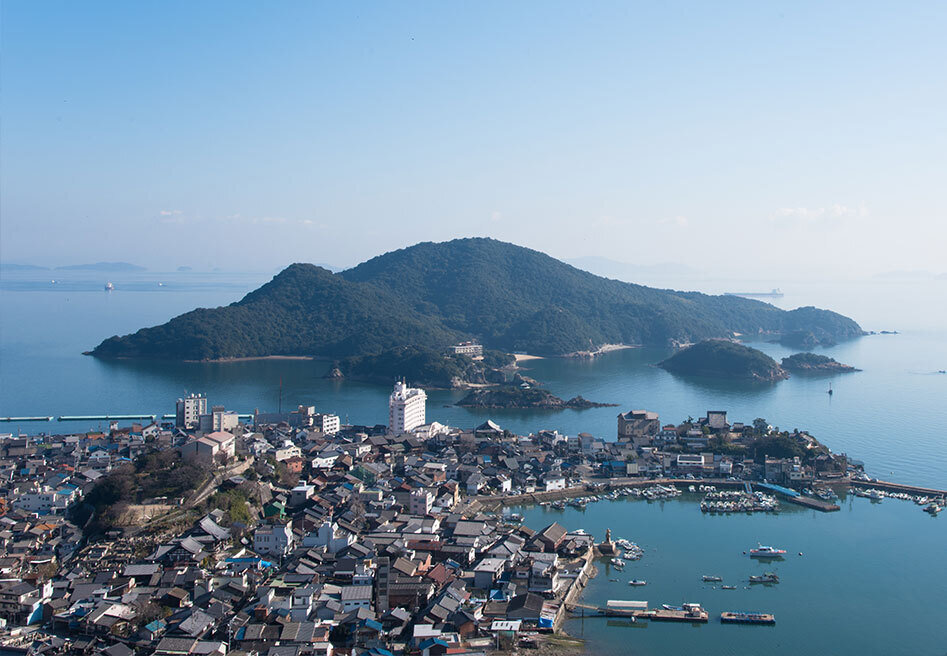
We often look at Tomo from the harbor side, but climbing up here provides a sweeping view encompassing the town, harbor, and the open sea beyond.
Looking down on the familiar streets from a higher vantage point offers a fresh perspective.
Here, while tracing the history of Tomo Castle, we introduce the background of how Tomonoura developed as a key strategic hub of the Seto Inland Sea.
Tomo Castle Ruins Overlooking the Harbor
Tomo Castle Ruins rest on a hill at the center of town, directly overlooking the harbor.
While the castle's exact origins remain unconfirmed, Fukuyama City records suggest the Murakami Suigun (navy) first built a fortification here.
Later, the Mōri clan also designated Tomonoura as a crucial stronghold, welcoming Ashikaga Yoshiaki, the final shogun of the Muromachi Shogunate, to Tomo.
A castle is believed to have already existed by that time.
Behind this strategic importance was Tomonoura's geographic location.
Situated near the center of the Seto Inland Sea, Tomo drew countless ships since ancient times as a harbor for "waiting out tides."
 When ships gather, not only people and goods accumulate, but also news and intelligence from across Japan.
Furthermore, a castle stood where it could watch over the entire harbor.
Tomonoura was far more than a simple port of call; it served as a vital lookout post monitoring the entire Seto Inland Sea.
Tomo, the Refuge of Ashikaga Yoshiaki
An indispensable figure when discussing Tomo Castle's history is Ashikaga Yoshiaki, the final shogun of the Muromachi Shogunate.
Exiled from Kyoto by Oda Nobunaga in 1573, Yoshiaki sought protection under the Mōri clan and entered Tomo in 1576.
Using Tomo as his base, Yoshiaki actively appealed to feudal warlords across Japan to revive the shogunate.
In that era, envoys from all over the country visited Tomonoura, making it a bustling center of political intelligence.
Though difficult to imagine from today's quiet streetscapes, Tomo was once a major stage for national politics.
Standing on Tomo Castle Ruins and looking out at the harbor, one can feel the grand scale of history played out here.
Because Tomonoura connects deeply with both the beginning and end of the Muromachi Shogunate--from Ashikaga Takauji to Ashikaga Yoshiaki--
it is famously declared that "The Ashikaga rose in Tomo and perished in Tomo."
Masanori Fukushima's Transformation into a Full Castle
A major turning point leading to the castle structure whose remnants exist today occurred after the Battle of Sekigahara.
In 1600, Masanori Fukushima, appointed lord of Aki and Bingo provinces, stationed senior vassal Genba Osaki in Tomo to refortify the castle, erecting a three-storied keep ("tenshu").
Tomo Castle at that time comprised not only a Honmaru (inner bailey) and Ninomaru (second bailey), but also a Sannomaru (third bailey).
Visualizing a three-storied keep towering above today's peaceful townscape might be challenging.
 Yet walking among remaining stone walls and natural terrain offers the delightful experience of imagining the castle's former glory.
Tomo Castle was decommissioned and abandoned in 1609.
Subsequently, Katsunari Mizuno, replacing the Fukushima clan in Bingo, placed the residence of his eldest son Katsutoshi on the castle site. Later, town magistrate offices ("machi-bugyosho") were established there, continuing its role as an administrative center for governing Tomo.
Why Not Walk from Castle Ruins Down to the Harbor?
When visiting Tomo Castle Ruins, our recommended course is to take in the views from the hilltop first, and then walk down to the harbor.
From around the Tomonoura History & Folklore Museum, you can look out over Tomonoura's streetscapes and the Seto Inland Sea stretching beyond.
Pause here briefly to observe how the town and sea align geographically.
 Afterward, descend along slopes through narrow alleys lined with traditional townhouses toward the harbor where the Joyato lantern stands.
Once at the harbor, turn around and look back toward the hilltop where the castle once stood.
Look down at the harbor from above, then look up at the castle hill from the harbor.
Walking this path makes you feel firsthand how deeply Tomo Castle was connected to the harbor.
Tomonoura is a town best enjoyed by paying attention to side streets and slopes along the way rather than rushing straight to destinations.
If time allows, take a relaxed stroll through these historical paths.
Tomonoura's History Visible from Castle Ruins
No castle keep remains on Tomo Castle Ruins today.
Yet viewing town and sea together from the ruins clarifies why Tomonoura was so vital throughout history.
The Seto Inland Sea we casually admire today was once a busy highway for samurai, merchants, and travelers carrying people, goods, and news.
Even after Tomo Castle vanished, Tomonoura continued flourishing as a port town.
Joyato lanterns, Gangi steps, Homeishu liquor, Korean Envoys (Joseon Tongsinsa), and Kitamaebune merchant ships--
stories featured in upcoming "Tomonoura Historical Chronicles" all tie directly into this harbor's rich history.
When visiting Hotel Ofutei, take a gentle walk up the hill to Tomo Castle Ruins while exploring the Joyato lantern and harbor streets.
Gaze at the sea from the ruins, then wander down alleys toward the harbor.
Walking in that order presents Tomonoura from an entirely new angle.
In our next issue of "Tomonoura Historical Chronicles," themed around "A Port for Waiting Out Tides Nurtured by Kitamaebune," we will introduce Tomonoura's further development as a premier port town.
【Reference Sites】
▷ Fukuyama City: "History of Tomo-cho (Early Modern)"
▷ Fukuyama City: "History of Tomo-cho (Ancient to Medieval)"
▷ Fukuyama City: "History of Tomo-cho (Location & Nature)"
The emojis on this site use Twemoji (© Twitter, Inc. and contributors). License: CC-BY 4.0