



2026.08.17
Sakamoto Ryoma and the "Iroha Maru Incident" | Footprints Remaining in Late-Edo Tomonoura
Tomonoura Historical Chronicles
Tomonoura Historical Chronicles Vol. 2
Tomonoura, which flourished as a port for waiting out tides, preserves countless stories of people who visited, departed from, and dearly cherished this town.
"Tomonoura Historical Chronicles" is a 12-part series introducing notable historical figures and events connected to Tomonoura.
Part 2 features Sakamoto Ryoma.
Widely known as a visionary who navigated the chaotic end of the Edo period to usher in a new era for Japan, Sakamoto Ryoma is strongly associated with Kochi, Nagasaki, and Kyoto. However, his footsteps are also deeply etched into the history of Tomonoura.
The event connecting Ryoma to Tomonoura was the "Iroha Maru Incident" of 1867. To negotiate compensation for a maritime collision, Ryoma stayed in Tomonoura to lead tense negotiations against the powerful Kishu Clan.
Here, we share the story of Sakamoto Ryoma and the Iroha Maru Incident, Ryoma-related historical sites preserved in Tomonoura today, and the local community that worked tirelessly to pass this heritage down to future generations.
The "Iroha Maru Incident" Connecting Ryoma to Tomonoura
On April 23, 1867, the Iroha Maru, carrying Sakamoto Ryoma and members of his navy-trading group Kaientai, collided with the Kishu Clan's warship Meiko Maru off the coast of Mushima (near present-day Kasaoka City, Okayama Prefecture).
Severely damaged, the Iroha Maru was towed toward Tomo Port, which offered well-equipped harbor facilities, but sank along the way. Fortunately, all crew members transferred safely to the Meiko Maru, and Ryoma's party landed at Tomonoura.
Determining liability for losses of the ship and cargo ignited tense negotiations between Kaientai and the Kishu Clan. What began as a single maritime accident in the Seto Inland Sea soon developed into the historic "Iroha Maru Incident."
Negotiations with the Kishu Clan Set in a Historic Port Town
 Upon landing at Tomonoura, Ryoma and Kaientai stayed at the residence of Seiemon Masuya, a shipping merchant. Meanwhile, the Kishu Clan established headquarters at Enfukuji Temple. Negotiations took place at neutral venues positioned between their lodgings--the house of Manzo Uoya and the Taichoro guest hall of Fukuzenji Temple.
Their opponent was the Kishu Clan, one of the three major branches of the ruling Tokugawa family. For Kaientai, an independent group lacking domain backing, it was by no means an equal negotiation.
Nevertheless, Ryoma forcefully argued Kishu's liability based on international maritime principles ("Bankoku Kohō"). Though four days of negotiations in Tomonoura ended without immediate resolution, discussions continued in Nagasaki. Ultimately, the Kishu Clan agreed to pay compensation, bringing widespread fame to Ryoma and Kaientai.
While hard to imagine from today's peaceful townscape, late-Edo Tomonoura once served as the stage for high-stakes negotiations that shook the nation.
Masuya Seiemon Residence: Where Ryoma Hid
During the Iroha Maru Incident, the Masuya Seiemon Residence served as Kaientai's secret headquarters. Because Ryoma was hunted by the Shogunate, he stayed under the alias "Umetaro Saitani."
 For generations, local lore insisted that "Ryoma slept in a hidden attic room." In 1989, local volunteers inspected the ceiling and discovered the hidden room preserved in its original state. Today, this room has been restored and is open to the public.
Standing inside the small, low-ceilinged room brings to life the image of Ryoma leading intense daytime negotiations before retreating to this hidden space at night. It is a place where a famous historical icon feels remarkably human and close.
Tomonoura Locals Search for the Lost "Iroha Maru"
The legacy of the Iroha Maru Incident belongs to more than Ryoma and Kaientai.
More than a century after the event, in the late Showa period, the residents of Tomonoura took action to verify this history firsthand.
In 1988, the "Tomo Lovers Association" conducted preliminary surveys to locate the sunken Iroha Maru. Confirming a seabed rise led to full-scale underwater archaeological investigations conducted from 1988 to 1989 and again in 2005.
According to Agency for Cultural Affairs records, these survey results confirmed an extremely high probability that the discovered wreck is indeed the Iroha Maru. Artifacts salvaged from the seabed included hull timbers, pulleys, and ceramics.
The shipwreck believed to be the Iroha Maru still rests quietly on the seabed off Ujishima Island, Fukuyama City, at a depth of approximately 27 meters.
The history of the Iroha Maru Incident we know today was not preserved solely through dusty records.
Because local residents took to the sea to search for physical evidence, an event from over 150 years ago emerged before us with vivid clarity.
Preserving History for the Future Through Community Power
Thanks to these community efforts, the Iroha Maru Incident is not just a distant event from the late Edo period, but a living cultural heritage that visitors to Tomonoura can feel close to.
At the "Iroha Maru Museum" located near the Joyato Lantern, visitors can view salvaged seabed artifacts, a shipwreck diorama, and survey photos.
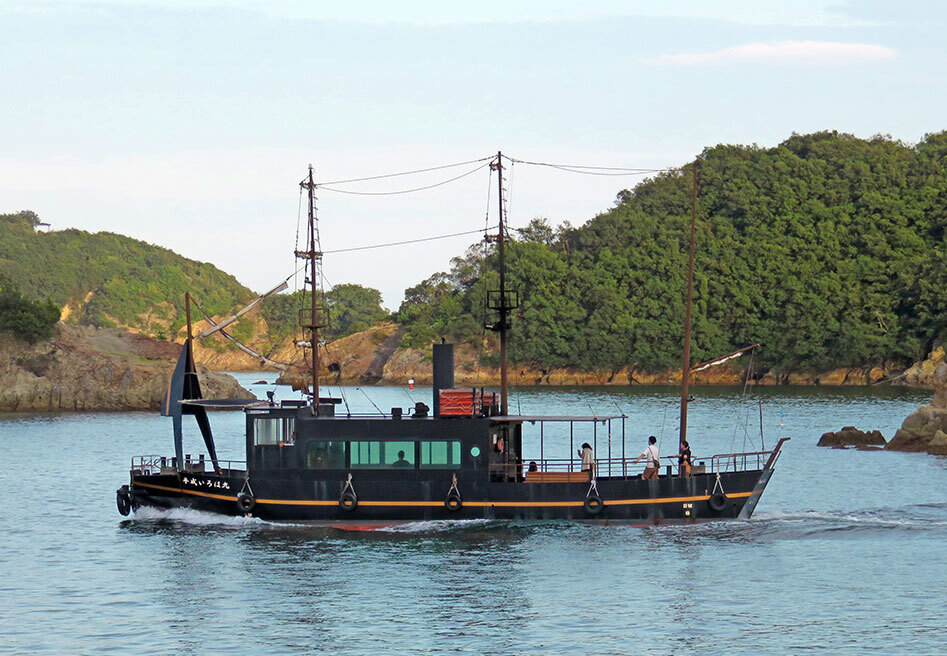
Additionally, the municipal ferry "Heisei Iroha Maru," launched in 2010 to connect Tomonoura and Sensui Island, was modeled after the original Iroha Maru. Even a short ferry ride allows travelers to feel the spirit of Ryoma's historic port town.
 Investigating history, searching the seabed, exhibiting discoveries, and sharing them as modern town attractions--the story surrounding the Iroha Maru embodies Tomonoura's unique community spirit of unearthing, protecting, and passing down local heritage to future generations.
Footprints of Ryoma and the Iroha Maru Remaining in Tomonoura
Walking through Tomonoura brings you face-to-face with sites connected to Ryoma and the Iroha Maru Incident. Sites including the former residence of Manzo Uoya (now "Ofunayodo Iroha"), Fukuzenji Taichoro, Enfukuji Temple, and the Masuya Seiemon Residence can all be comfortably toured on foot.
Stopping by the Iroha Maru Museum near the Joyato Lantern allows you to see salvaged artifacts and survey records, offering a tangible connection to the events that unfolded in these waters over 150 years ago.
 Strolling through narrow alleys, past historic townhouses, and toward the harbor lantern, why not trace the enduring footprints of Sakamoto Ryoma?
Understanding History Makes Town Walks Even More Delightful
Sakamoto Ryoma stayed in Tomonoura for only a few days.
Yet those few days surrounding the Iroha Maru Incident transformed late-Edo Tomonoura into a major stage of Japanese history.
Gazing over the peaceful harbor brings to mind Ryoma's determination during negotiations and the tireless efforts of Kaientai members dealing with their sunken ship.
 What brought this history to us over a century later extends beyond old buildings and documents. The dedication of local residents who searched for the Iroha Maru, surveyed the seabed, and shared its story is itself part of Tomonoura's history.
Reflecting on the thoughts of those who walked these streets long ago--and how today's residents continue protecting this legacy--offers a deeper, richer perspective on Tomonoura's historic streetscapes.
Alongside your stay at Hotel Ofutei, take time to discover another side of Tomonoura, where dramatic samurai narratives and community devotion live on together.
In our next issue of "Tomonoura Historical Chronicles," we will introduce stories connecting Ashikaga Takauji with Tomonoura.
【Reference Materials】
▷ Fukuyama City: "Sakamoto Ryoma and Tomo"
▷ Fukuyama City: "About Tomonoura"
▷ Fukuyama City: "Iroha Maru Museum"
▷ Fukuyama Tourism & Convention Association: "Masuya Seiemon Residence (Ryoma's Hidden Room)"
▷ Kyoto City Archaeological Research Institute: "Sakamoto Ryoma's Iroha Maru"
The emojis on this site use Twemoji (© Twitter, Inc. and contributors). License: CC-BY 4.0