



2026.08.24
Tomonoura Depicted in the Man'yōshū | Otomo no Tabito and His Love for His Late Wife Entrusted to the "Muro-no-ki"
Tomonoura Historical Chronicles
Tomonoura Historical Chronicles Vol. 4
Tomonoura, which flourished as a port for waiting out tides, preserves countless stories of people who visited, departed from, and dearly cherished this town.
"Tomonoura Historical Chronicles" is a 12-part series introducing notable historical figures and events connected to Tomonoura.
Part 4 features Otomo no Tabito, a poet of the Nara period, and the story surrounding Tomonoura's legendary "Muro-no-ki" (juniper tree).
Walking through Tomonoura, with its Joyato lantern and historic townhouses, one senses long-standing history everywhere.
That history is even older than we might imagine, with the name "Tomo" appearing in the Man'yōshū poetry anthology nearly 1,300 years ago.
Here, through Otomo no Tabito's poem composed in Tomonoura and the "Muro-no-ki Poem Monument" that remains in town today, we introduce Tomonoura as it was 1,300 years ago and the deep affection felt for a loved one.
Tomonoura as Seen by Otomo no Tabito 1,300 Years Ago
Otomo no Tabito was one of the prominent poets representing the Nara period and the father of the famous Man'yōshū poet Otomo no Yakamochi.
Serving the Imperial Court as a statesman, in his later years he served as Dazai no Sochi (Governor-General of Dazai Governance) governing Dazaifu in Kyushu.
His wife accompanied him on his journey to take up his post in Dazaifu, but sadly passed away while there.
In 730, Tabito, returning to the capital, stopped at Tomonoura along his journey.
The Tomonoura he had once viewed together with his wife was now something he gazed upon alone.
The same sea, the same rocky shore, and the same "Muro-no-ki" tree standing unchanged.
Because the scenery remained completely unchanged, he may have felt the absence of the person who should have been beside him even more acutely.
Tabito poured those heart-wrenching feelings into a poem.
Love for a Late Wife Overlayed upon the "Muro-no-ki"
Here is the poem he composed at that moment:
吾妹子が 見し鞆の浦の むろの木は
常世にあれど 見し人そなき
(Wagimoko ga mishi tomonoura no muronoki wa / tokoyo ni aredo mishi hito so naki)
This poem translates to: "The Muro-no-ki tree at Tomonoura, which my beloved wife once gazed upon, remains here unchanged for eternity--yet she who looked upon it with me is gone forever."
The "Muro-no-ki" is understood to be an evergreen juniper tree. A tree standing eternally unchanged versus a beloved wife who can never be met again.
Though composed 1,300 years ago, revisiting a place once traveled with someone precious and suddenly recalling them is an emotion that resonates deeply with us living today.
A poem from a distant past, yet strangely familiar and close to the heart.
That timeless resonance is perhaps part of this poem's true charm.
Encountering the "Muro-no-ki Poem Monument" on a Town Walk
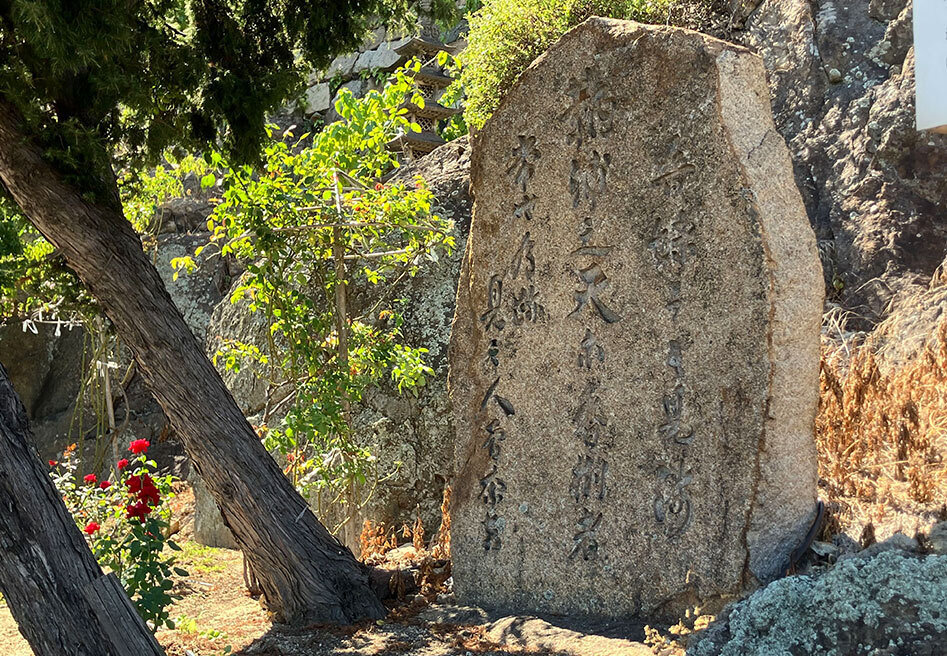
Otomo no Tabito's poem can still be encountered in Tomonoura today.
Located opposite the municipal ferry terminal, below the stone wall of Fukuzenji Temple's Taichoro guest hall, stands the "Muro-no-ki Poem Monument."
 Because it sits along the walking path toward the Joyato lantern, you might easily pass it by without noticing.
Our staff recommends taking a moment to pause here rather than simply glancing and moving on.
Look out at the sea of Tomonoura, the very waters Tabito gazed upon while yearning for his late wife.
Naturally, the town's appearance has changed dramatically over 1,300 years.
Even so, standing in the same place at Tomonoura and looking at the sea makes a story recorded in the Man'yōshū feel remarkably real and close.
From the poem monument to Taichoro, and then onward to the Joyato lantern.
Strolling in that order is a wonderful way to enjoy Tomonoura, enriched by historical knowledge.
"Muro-no-ki" Confectionery at Ofutei's Gift Shop
Interestingly, you can also find "Muro-no-ki" at Hotel Ofutei's gift shop.
Rather than a real tree, this refers to "Muro-no-ki," a signature local sweet crafted by Mikawaya, a Fukuyama Japanese confectionery maker founded in 1921.
 "Muro-no-ki" was selected as one of the "Fuku-no-yama 100 Selections" commemorating Fukuyama City's 100th anniversary.
Designed to resemble tree bark, the crumbled dough uses almond powder for a fragrant, savory finish.
Inside, a rich red bean paste is blended with chestnuts, orange peel, and raisins soaked in wine and rum.
Biting into it releases a gentle sweetness accompanied by fruity aromas.
After learning about Otomo no Tabito's poem and visiting the monument, seeing this name in our gift shop brings a special sense of connection to the words "Muro-no-ki."
It is a staff-recommended souvenir to take home along with your town walk memories.
Overlaying 1,300 Years Ago with Present-Day Tomonoura
The sea of Tomonoura we casually gaze upon today was viewed 1,300 years ago by someone overlaying their precious memories onto the landscape.
Realizing this, the Man'yōshū stops being an ancient tale and feels like a living chapter of history extending into this town today.
When exploring Tomonoura, take a brief moment to stop at the "Muro-no-ki Poem Monument" on your way to the Joyato lantern or Taichoro.
Visit the monument, look out at the sea Tabito beheld, and stroll through historic streets.
And upon returning to the hotel, be sure to look for the "Muro-no-ki" confectionery in our gift shop.
Exploring Tomonoura with knowledge of a 1,300-year-old poem reveals a slightly different, richer side of this historic port town.
In our next issue of "Tomonoura Historical Chronicles," we will introduce "Tomo Castle," which accumulated centuries of history as a strategic Seto Inland Sea stronghold.
【Reference Materials】
▷ Fukuyama City: "Connections Between the Era Name 'Reiwa' and 'Tomonoura'"
▷ Fukuyama City: "History of Tomo-cho (Ancient to Medieval)"
▷ Nara Prefectural Manyo Cultural Museum Manyo Encyclopedia: "Vol. 3-446"
▷ Nara Prefectural Manyo Cultural Museum Manyo Encyclopedia: "Vol. 3-447"
▷ Nara Prefectural Manyo Cultural Museum Manyo Encyclopedia: "Vol. 3-448"
▷ Fukuyama Tourism & Convention Association: "Muro-no-ki Poem Monument"
The emojis on this site use Twemoji (© Twitter, Inc. and contributors). License: CC-BY 4.0